Import DICOM
Import DICOM files into your project.
Steps
-
Open DICOM Wizard Module
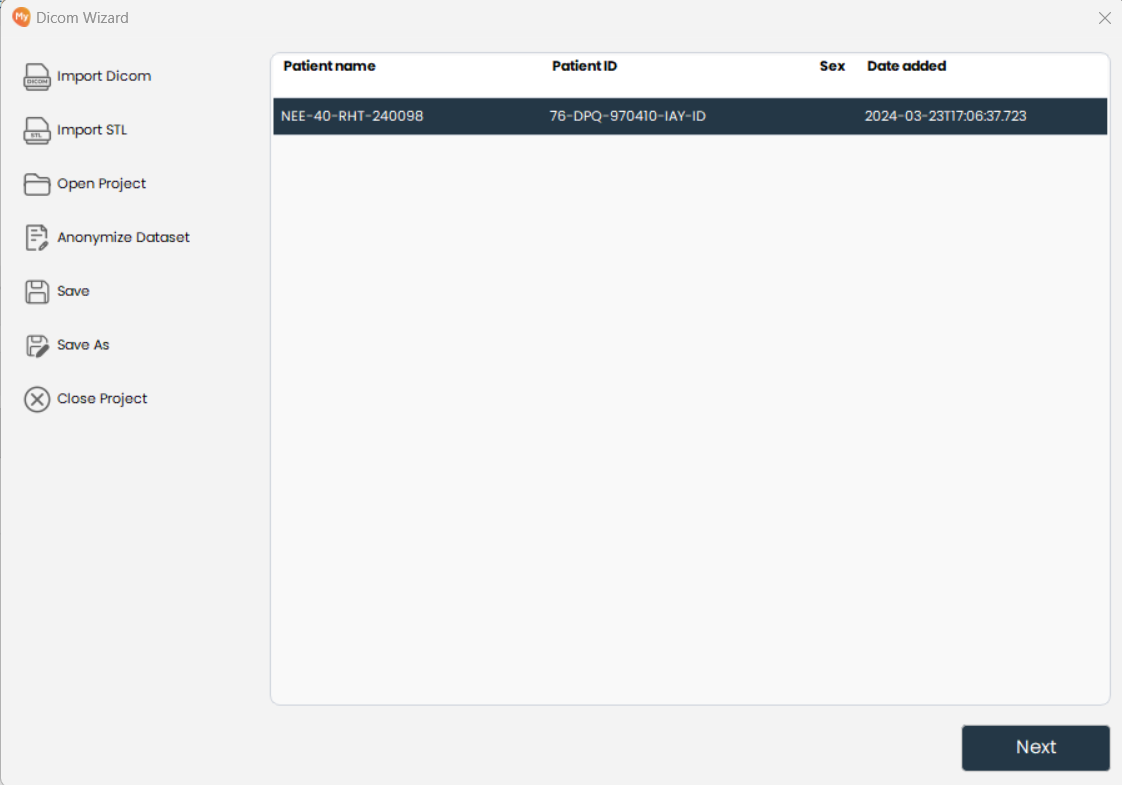
- Open the DICOM Wizard module from the sidebar to begin the import process.
-
Click on Import DICOM or DICOM volume Button
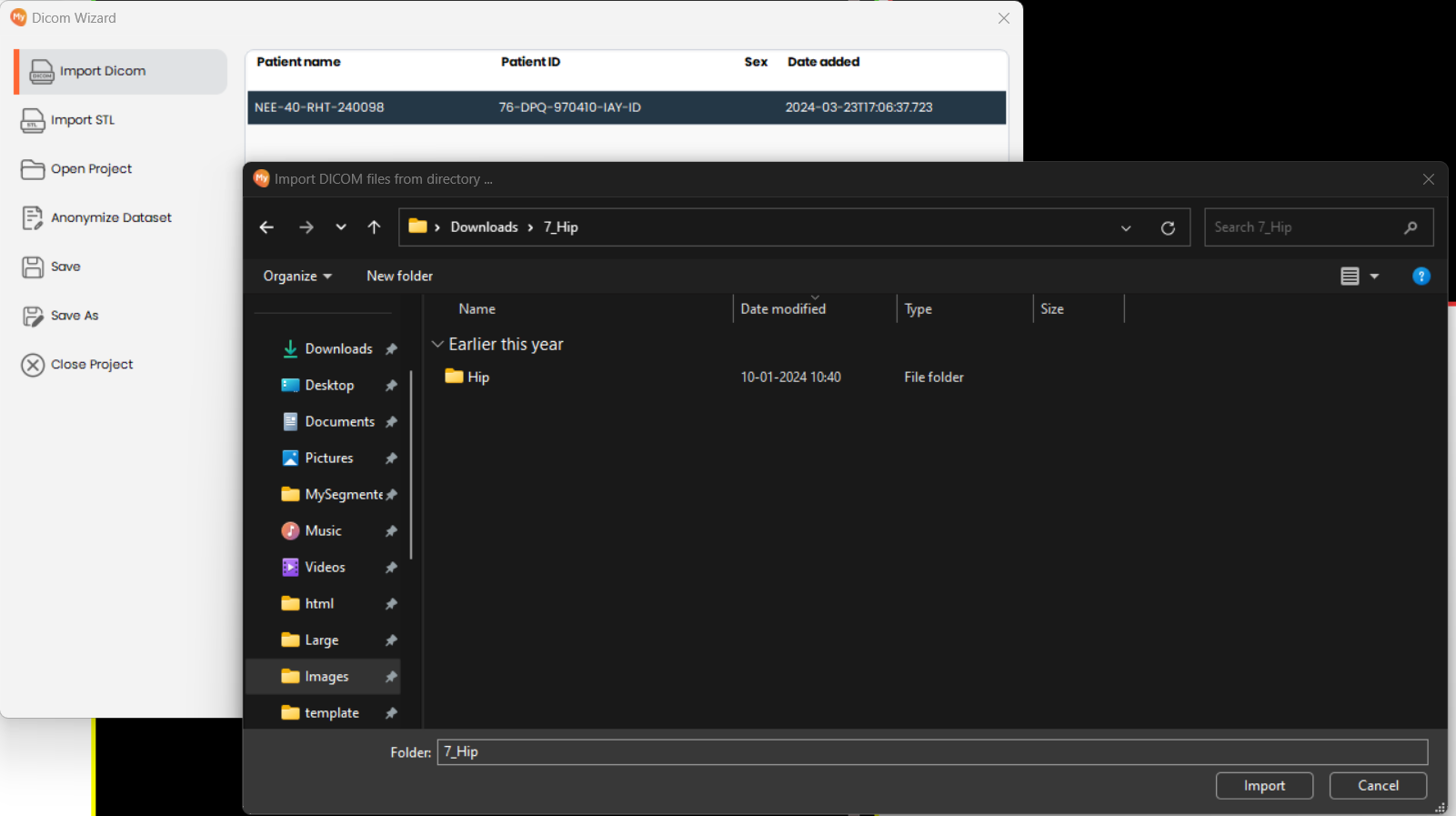
- Click on the Import DICOM button on the left sidebar. This will open a file explorer dialog where you can navigate to the folder containing your DICOM files
-
Select the Directory with DICOM Files
- Navigate to and select the directory containing your DICOM files. Ensure all files belonging to the same scan series are within the same directory for complete and accurate loading.
-
Select the Series in the Import Wizard
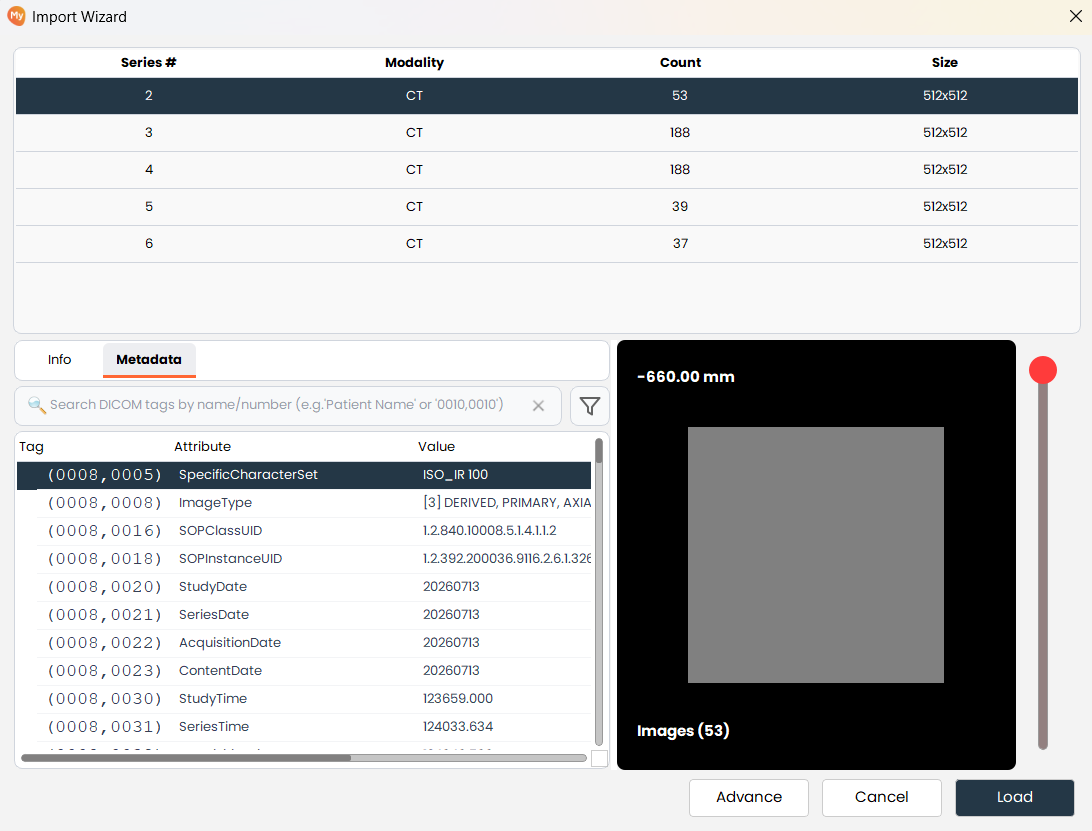
- The import wizard lists all detected DICOM series within the chosen directory. Select the series you wish to import; each entry corresponds to a distinct image sequence or scan.
-
Preview and Metadata
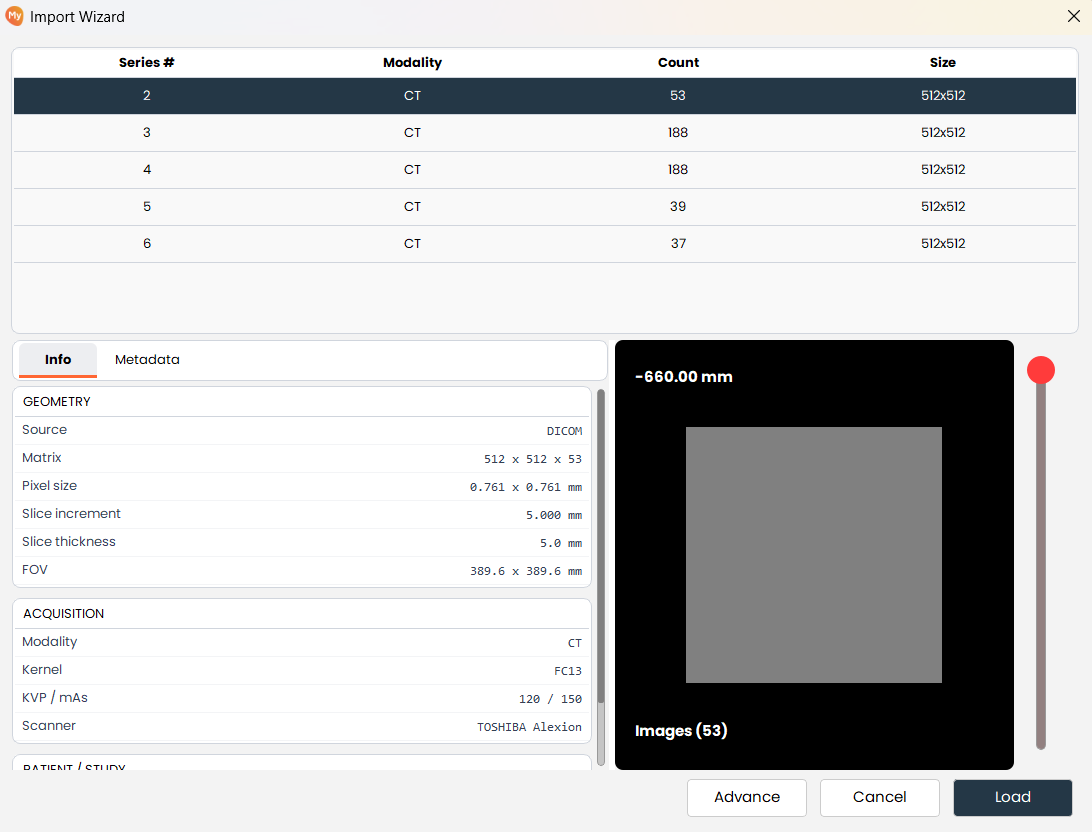
-
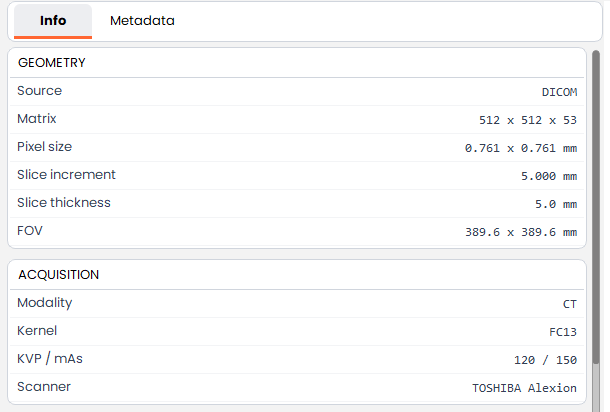
Switch between the "Preview" and "Show Metadata" tabs to inspect the images and their associated metadata. The Preview tab allows you to visually inspect the images. The metadata pane contains two tabs: the Info tab (default), which summarizes key geometry, acquisition, and patient/study details of the selected series, and the Metadata tab, which provides detailed information about each image through the full DICOM tag tree. Refer to Info and Metadata Tabs below for details.
-
-
Advanced Options
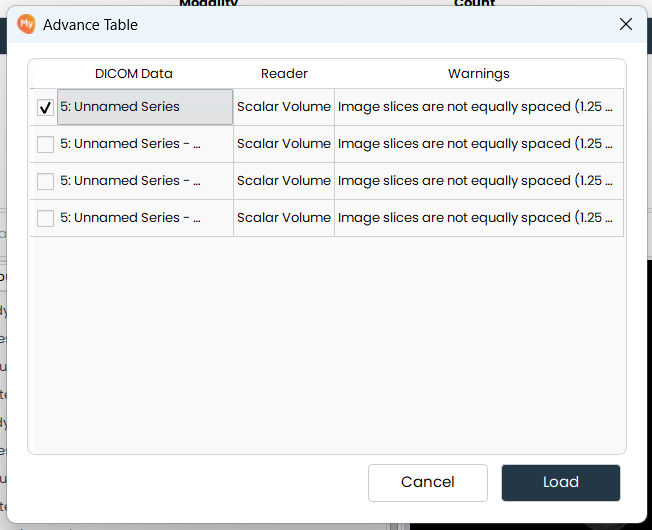
- Click the "Advance" button to explore additional options for importing and processing your DICOM files.
-
Click on Load Button
- Click on the
Loadbutton to load the selected DICOM series into your project. This will make the images available for further analysis and manipulation.
- Click on the
Info and Metadata Tabs
The Import Wizard displays all available DICOM tags, making it comprehensive but difficult to review. The Info tab provides key geometry, acquisition, and patient details in a dedicated panel, allowing users to quickly assess and compare series without searching through numerous tags. Additionally, three key values are also shown in the Info tab:
- Pixel Size
- Field of View
- Slice Increment
Metadata pane tabs The metadata pane includes a tab strip with two tabs:
- Info: new; shows series-level information in three sections (Geometry, Acquisition, and Patient / Study). This is the default tab.
- Metadata: the existing metadata tree, unchanged. The search box and the column filter are now located under the Metadata tab, and the column filter is shown as an icon instead of the text "Column".
Nothing else in the wizard changes. The series table, metadata tree, preview, slider and all three buttons behave exactly as before.
Info tab contents
The Info tab shows twelve rows in three sections. The values in the table below are examples only.
| Section | Row | Example |
|---|---|---|
| Geometry | Source | DICOM |
| Geometry | Matrix | 512 x 512 x 508 |
| Geometry | Pixel | size 0.840 x 0.840 mm |
| Geometry | Slice increment | 1.250 mm |
| Geometry | Slice thickness | 1.0 mm |
| Geometry | FOV | 430 x 430 mm |
| Acquisition | Modality | CT |
| Acquisition | Kernel | B30f |
| Acquisition | KVP / mAs | 120 / 250 |
| Acquisition | Scanner | SIEMENS SOMATOM |
| Patient / Study | Patient | Anonymous |
| Patient / Study | Study | Chest CT |
When a value cannot be determined
- Every row is always present when a series is selected.
- Slice Increment on a single-image series shows N/A (single slice).
- Slice Increment where slices are unevenly spaced shows a range instead of one number, for example 1.000 - 3.000 mm (irregular).
- Any value whose source tag is missing, or that cannot be determined, shows Unavailable.
Info Tab Values
Values read directly from tags
- Modality (0008,0060), Slice thickness (0018,0050) and Study (0008,1030) are shown as stored.
The following values are read from tags but reshaped for display:
- Pixel size: from PixelSpacing (0028,0030), a backslash-separated pair. The tag stores row spacing first, then column spacing; the value is displayed column first to match Matrix.
- Kernel: ConvolutionKernel (0018,1210) may carry several values; they are joined with commas.
- KVP / mAs: two tags (0018,0060 and 0018,1152) shown on one row.
- Scanner: Manufacturer (0008,0070) and Manufacturer’s Model Name (0008,1090) joined; whichever is present is shown when one is missing.
- Patient: Patient’s Name (0010,0010) uses ^ between name components; these are replaced with spaces.
- Matrix: combines Rows (0028,0010) and Columns (0028,0011) with the number of instances in the series, which is a database count rather than a tag. It is the same figure the preview shows as Images (N).
- Source: not a tag; it reports which import path produced the series
Values that are computed
-
Field of View (FOV): computed as image width x image height, in millimeters (number of columns x column pixel spacing, by number of rows x row pixel spacing).
-
Slice Increment: computed from the spacing between consecutive slices of the series. If a computed value cannot be determined, the row shows N/A or N/A (single slice). No error message is shown
Metadata List Keyboard Navigation
- Up and Down arrow keys move the selected row.
- Left and Right arrow keys collapse and expand rows that contain sequences.
- Page Up and Page Down move a screen at a time; Home and End go to the first and last row.
- The first row is selected when a series is opened, so the arrow keys work straight away.
Panel Resizing
- The divider between the metadata panel and the preview panel can be dragged left or right.
- The divider between the metadata panel and the series table can be dragged up or down.
- The panels return to their standard proportions each time the wizard is opened.
If DICOM Data is Already Loaded
- Open Import Wizard
- Click on the loaded DICOM data to open the Import Wizard. This allows you to manage and view the series that have already been imported.Other things are same as import DICOM from step 4 to 7.
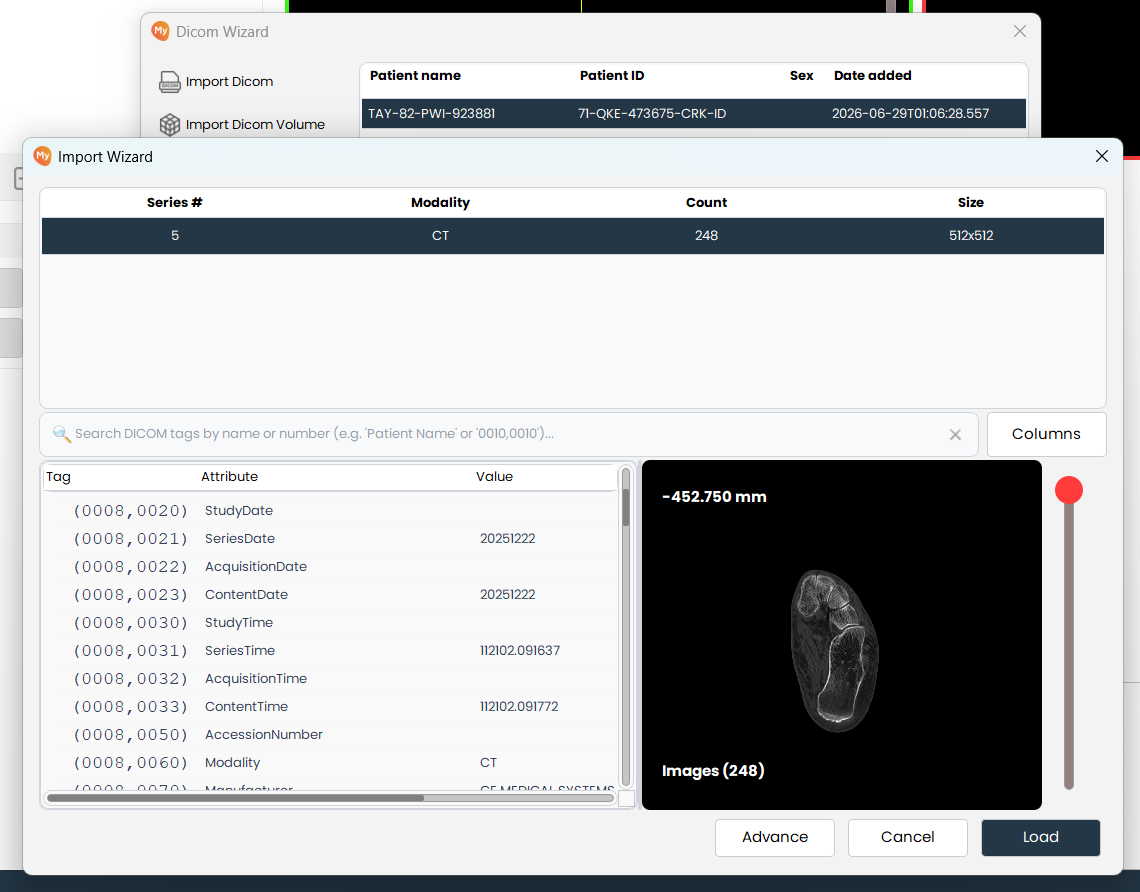
- Click on the loaded DICOM data to open the Import Wizard. This allows you to manage and view the series that have already been imported.Other things are same as import DICOM from step 4 to 7.